PCB Conformal Coating Services for High-Reliability Electronics
Protect your electronic assemblies from moisture, chemicals, dust, vibration, thermal stress, and harsh operating environments with Sierra Assembly’s PCB conformal coating services. With 30 years of electronics manufacturing experience, we provide precision circuit board conformal coating solutions designed to improve reliability, reduce field failures, and support mission-critical applications.
From prototype PCB assemblies to full-scale production, our engineering-driven team delivers IPC-compliant coating solutions for aerospace, medical, industrial, automotive, telecommunications, and defense electronics.
-
IPC-CC-830 Compliant Processes
-
ISO 9001:2015 and AS9100D Standards
-
Prototype to Production Support
-
Advanced X-Ray Inspection
-
RoHS Compliant Manufacturing
-
Fast Turnaround & Engineering Support
Trusted PCB Conformal Coating Manufacturing Partner
Sierra Assembly provides high-reliability PCB conformal coating services for OEMs, engineers, and electronics manufacturers requiring long-term protection and consistent manufacturing quality. Our coating solutions help protect electronic assemblies from environmental exposure while improving durability and operational performance.
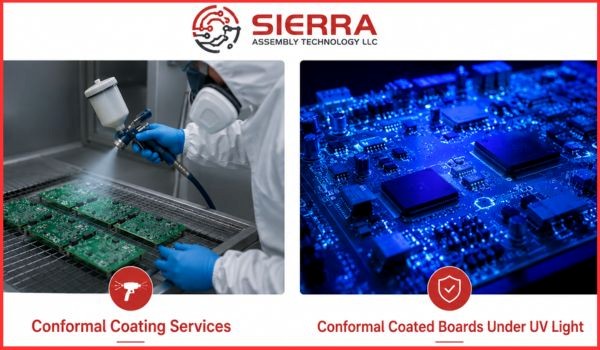
We support low, medium, and high-volume production with strict process control, advanced inspection systems, and engineering support throughout every stage of manufacturing.
PCB Conformal Coating Capabilities
Sierra Assembly offers a complete range of PCB conformal coating services designed for commercial, industrial, aerospace, medical, and defense electronics.
Silicone Conformal Coating
Flexible, high-temperature resistant coating designed for harsh environments and thermal cycling applications.
Key Benefits
-
Excellent moisture & humidity resistance
-
Operating range from -55°C to 200°C
-
UV, salt spray & thermal protection
-
Ideal for aerospace & industrial electronics
-
IPC-CC-830 compliant options available
Acrylic Conformal Coating
Cost-effective PCB coating solution with fast curing and easy rework capability.
Key Benefits
-
Fast drying process
-
Excellent dielectric strength
-
Moisture & abrasion resistance
-
Easy removal & repair
-
MIL-I-46058C compliant coatings available
Parylene Conformal Coating
Ultra-thin vapor deposition coating for high-reliability electronics and complex PCB assemblies.
Key Benefits
-
Uniform pinhole-free protection
-
Excellent chemical & moisture resistance
-
Ideal for medical & aerospace electronics
-
Low outgassing performance
-
Suitable for FDA & NASA-related applications
Epoxy Conformal Coating
Durable protective coating designed for rugged industrial environments.
Key Benefits
-
Strong chemical resistance
-
High abrasion protection
-
Excellent mechanical durability
-
Reliable high-temperature performance
-
Ideal for industrial electronics
Polyurethane Conformal Coating
High-performance coating solution for aerospace and harsh-environment applications.
Key Benefits
-
Excellent moisture & chemical protection
-
Strong adhesion properties
-
High dielectric performance
-
Resistant to humidity & fuel vapors
-
Suitable for demanding environments
Thin Film & Nano Coatings
Lightweight protective coatings for compact and miniaturized electronic assemblies.
Key Benefits
-
Ultra-thin coating layer
-
Minimal impact on component size
-
Surface-level moisture protection
-
Ideal for space-constrained electronics
-
Suitable for selective applications
Conformal Coating Application Methods
Sierra Assembly offers multiple coating application methods based on your PCB design, production volume, and performance requirements.
Brush Coating
Selective manual coating ideal for prototypes, touch-ups, and PCB rework applications.
Dip Coating
Complete PCB immersion coating process designed for high-volume production and full board protection.
Spray Coating
Automated or manual spray coating process that delivers uniform, high-quality coverage for complex PCB assemblies.
Vapor Deposition Coating
Precision parylene coating process that provides ultra-thin, pinhole-free protection with excellent moisture and chemical resistance.
Conformal Coating Removal & Rework Services
Sierra Assembly provides safe and controlled conformal coating removal services for PCB repair, BGA rework, component replacement, and engineering modifications.
Removal & Rework Capabilities
-
Precision coating removal for PCB repair
-
BGA rework & component replacement support
-
Controlled stripping processes for sensitive assemblies
-
Safe removal methods for acrylic, silicone, epoxy & parylene coatings
-
Minimal impact on PCB circuitry and components
-
Engineering support for complex rework applications
Our rework process helps maintain board integrity while minimizing the risk of damage during repair or modification.
Advanced PCB Coating Capabilities
Sierra Assembly combines advanced manufacturing processes, precision inspection systems, and engineering expertise to deliver reliable conformal coating solutions for demanding electronic applications.
Advanced Capabilities Include
-
Precision thin-film and selective coating applications
-
Moisture, chemical & corrosion resistance
-
Advanced PCB cleaning & surface preparation
-
X-Ray & thickness verification inspection
-
Thermal and mechanical protection solutions
-
UV-traceable coating materials
-
High dielectric & chemical-resistant coatings
-
Thermal management support for BGA & LGA assemblies
-
FDA, IPC & military-compliant coating processes available
Our engineering-driven approach helps ensure coating consistency, long-term reliability, and scalable production support.
Conformal Coating Inspection & Quality Control
Every coated assembly undergoes strict inspection and quality verification to ensure reliable protection and manufacturing accuracy.
Our Inspection Capabilities Include
-
PCB cleaning & surface preparation
-
Precision masking & selective coating
-
Automated and manual coating application
-
X-Ray & UV inspection
-
Thickness verification & quality testing
-
Advanced process control for coating consistency
Our quality-focused manufacturing process helps ensure every assembly meets strict reliability and performance requirements.
Why Choose Sierra Assembly
Sierra Assembly delivers reliable PCB conformal coating solutions backed by decades of electronics manufacturing experience and engineering-driven support. We work closely with OEMs, product developers, and manufacturers to provide coating solutions tailored to demanding applications and long-term product reliability.
What Sets Us Apart
-
Expertise with Complex PCB & BGA Assemblies
-
Prototype to High-Volume Manufacturing Capabilities
-
Fast RFQ Response & Reliable Lead Times
-
Customer-Focused Project Management
-
Flexible Manufacturing for Diverse Industries
-
Scalable Production Support for Growing Programs
-
Process-Driven Quality & Manufacturing Consistency
-
Reliable Support for Aerospace, Medical & Industrial Electronics
Our team focuses on helping you reduce manufacturing risk, improve product durability, and streamline production from prototype development through full-scale manufacturing.
Frequently Asked Questions
1. What is PCB conformal coating?
Ans: PCB conformal coating is a protective polymer layer applied to printed circuit boards to protect electronic components from moisture, chemicals, dust, corrosion, and harsh environmental conditions.
2. Which conformal coating is best for my application?
Ans: The ideal coating depends on your operating environment, thermal exposure, compliance requirements, and PCB design. Sierra Assembly’s engineering team helps you select the right coating solution for your application.
3. Do you support prototype PCB conformal coating?
Ans: Yes. We support prototype, low-volume, and high-volume PCB conformal coating services with scalable manufacturing support.
4. Do you provide IPC-compliant conformal coating services?
Ans: Yes. Our processes support IPC-CC-830, MIL-I-46058C, RoHS, and other industry compliance standards.
5. Can you support complex BGA assemblies?
Ans: Yes. We specialize in coating and protecting complex PCB assemblies, including fine-pitch and BGA-based electronic designs.
Ready to Protect Your PCB Assemblies?
Partner with Sierra Assembly for reliable PCB conformal coating services backed by engineering expertise, advanced inspection systems, and scalable manufacturing support.
Whether you require silicone conformal coating, acrylic coating, parylene coating, or complete circuit board coating solutions, our team is ready to support your next project.
Request a Quote