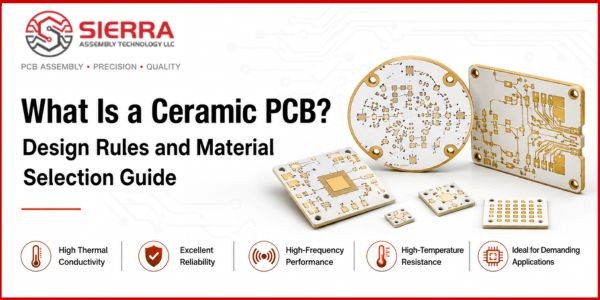
What Is a Ceramic PCB? Design Rules and Material Selection Guide

Jun 02,2026
As electronic devices become more powerful and compact, efficient thermal management has become a critical factor in PCB design. Traditional FR4 circuit boards perform well in many applications, but they often struggle in environments that demand high heat dissipation, electrical stability, and long-term reliability.

This is where a ceramic PCB offers a significant advantage. A ceramic substrate PCB provides excellent thermal conductivity, strong electrical insulation, and superior performance in high-temperature and high-frequency applications. From aerospace and defense systems to automotive electronics and medical devices, ceramic technology is helping engineers design more reliable products.

In this guide, we’ll explore what a ceramic circuit board is, the different types of ceramic PCB material, key design considerations, advantages and limitations, and how to select the right solution for your application.


What Is a Ceramic PCB?

A ceramic PCB is a type of ceramic printed circuit board that uses a ceramic substrate instead of traditional FR4 fiberglass material. The ceramic base serves as the foundation for the copper circuitry while providing excellent heat transfer and electrical insulation.

Unlike standard PCBs, a ceramic PCB board can operate in harsh environments where high temperatures, high voltages, and demanding electrical requirements are common.


Common ceramic substrate materials include:
  • Alumina (Al₂O₃)
  • Aluminum Nitride (AlN)
  • Beryllium Oxide (BeO)
  • Low-Temperature Co-Fired Ceramic (LTCC)
  • High-Temperature Co-Fired Ceramic (HTCC)
Because of their exceptional thermal and electrical properties, ceramic PCBs are widely used in high-power electronics, RF systems, LED lighting, and industrial applications.

Need a high-performance ceramic PCB for your next project? Contact Sierra Assembly today for expert engineering support, quick-turn manufacturing, and a fast quote on your ceramic PCB requirements.

Why Are Ceramic PCBs Used in Electronics?

Modern electronic systems generate significant amounts of heat. If this heat is not properly managed, components may experience performance degradation, reduced lifespan, or complete failure.

A ceramic substrate PCB helps overcome these challenges by offering:

  • Excellent thermal conductivity
  • High-temperature resistance
  • Strong electrical insulation
  • Low thermal expansion
  • Superior dimensional stability
  • Improved reliability in harsh environments
  • Excellent RF and microwave performance

Types of Ceramic PCB Materials

Selecting the right ceramic PCB material is one of the most important decisions in the design process.

Alumina (Al₂O₃) Ceramic PCB
Alumina is the most widely used ceramic substrate because it offers an excellent balance between performance and cost.

Key Benefits:
  • Cost-effective solution
  • Good thermal conductivity
  • High mechanical strength
  • Reliable electrical insulation
Common Applications:
  • LED modules
  • Industrial controls
  • Power electronics
  • Consumer electronics
Aluminum Nitride (AlN) Ceramic PCB
Aluminum Nitride provides significantly higher thermal conductivity than alumina, making it ideal for demanding thermal applications.

Key Benefits:
  • Exceptional heat dissipation
  • Low thermal expansion
  • Excellent electrical insulation
  • Suitable for high-power designs
Common Applications:
  • RF systems
  • EV power modules
  • Aerospace electronics
  • High-power semiconductor devices
Beryllium Oxide (BeO) Ceramic PCB
Beryllium Oxide offers outstanding thermal performance and is commonly used in specialized applications.

Common Applications:
  • Aerospace systems
  • Defense electronics
  • High-power RF applications
Low-Temperature Co-Fired Ceramic (LTCC)
LTCC technology supports compact and highly integrated circuit designs.

Applications:
  • RF modules
  • Wireless communication devices
  • Sensor systems
High-Temperature Co-Fired Ceramic (HTCC)
HTCC provides excellent durability and reliability for demanding environments.

Applications:
  • Aerospace electronics
  • Automotive systems
  • Military equipment

Ceramic PCB Material Comparison

Material

Thermal Conductivity

Main Advantage

Typical Applications

Alumina (Al₂O₃)

Moderate

Cost-effective

LEDs, Industrial Electronics

Aluminum Nitride (AlN)

Excellent

Superior Heat Dissipation

Power Electronics, RF Systems

Beryllium Oxide (BeO)

Very High

Extreme Thermal Performance

Aerospace, Defense

LTCC

Moderate

Multilayer Integration

RF Modules, Sensors

HTCC

Moderate

High Reliability

Aerospace, Automotive


Key Ceramic PCB Design Rules

1. Thermal Management Considerations
Effective heat management should be a primary focus when designing a ceramic PCB.

Best practices include:
  • Optimizing heat flow paths
  • Using appropriate copper thickness
  • Positioning high-power components strategically
  • Reducing thermal bottlenecks
2. Trace Width and Spacing Guidelines
Trace dimensions should be selected based on current requirements, operating voltage, and manufacturing capabilities.
Proper spacing helps improve electrical reliability and reduces the risk of failure.


3. Component Placement Strategies
Engineers should carefully place heat-generating components to avoid thermal concentration areas and improve overall board performance.

4. Via Design Considerations
Thermal vias can improve heat transfer and help distribute heat across the board more effectively.

5. High-Frequency Design Requirements
Ceramic materials provide excellent dielectric stability, making them ideal for RF and microwave applications where signal integrity is critical

How to Choose the Right Ceramic PCB Material

  • Based on Thermal Performance: For high-power applications, Aluminum Nitride is often the preferred choice due to its superior thermal conductivity.
  • Based on Electrical Requirements: RF and microwave designs benefit from ceramic materials that provide stable dielectric properties and low signal loss.
  • Based on Operating Environment: Applications exposed to vibration, temperature cycling, or harsh environments may require advanced ceramic solutions such as HTCC or specialized multilayer ceramic PCB technologies.
  • Based on Cost and Budget: Alumina remains one of the most cost-effective ceramic materials while still offering excellent performance for many applications.

Common Applications of Ceramic PCBs

Industry

Typical Applications

Aerospace & Defense

Radar systems, satellite communications, avionics, military electronics

Automotive Electronics

EV battery management systems, power converters, LED headlights, engine control modules, charging infrastructure

Medical Devices

Medical imaging equipment, diagnostic devices, laser systems, implantable medical technologies

RF & Microwave Systems

RF amplifiers, microwave circuits, wireless communication systems, satellite communication equipment

Industrial Equipment

Motor drives, industrial automation systems, power supplies, monitoring equipment

Power Electronics & EV Systems

Power modules, inverters, semiconductor packaging, renewable energy systems, electric vehicle power electronics


Our engineering team can help you choose the most effective solution based on your thermal, electrical, and manufacturing requirements. Request a quote today.

Ceramic PCB vs FR4 PCB: Key Differences

Choosing between a ceramic PCB and FR4 depends on the application's thermal, electrical, and reliability requirements.

Feature

Ceramic PCB

FR4 PCB

Thermal Conductivity

Excellent

Moderate

High-Temperature Resistance

Excellent

Limited

Electrical Insulation

Excellent

Good

RF Performance

Excellent

Standard

Dimensional Stability

High

Moderate

Reliability

Excellent

Good

Cost

Higher

Lower


When Should You Choose a Ceramic PCB?

A ceramic PCB is often the best solution when standard FR4 materials cannot meet thermal, electrical, or reliability requirements.

Consider a ceramic PCB when your application requires:
  • High-power operation
  • Superior heat dissipation
  • High-frequency signal performance
  • Long-term reliability
  • Operation in harsh environments
  • High-temperature resistance
For less demanding applications where cost is the primary concern, FR4 may still be the most practical choice.

However, when performance and reliability are critical, ceramic technology provides significant advantages.

Need Help Determining Whether a Ceramic PCB Is Right for Your Project? Contact Sierra Assembly today for engineering support and expert guidance on selecting the right ceramic PCB solution for your application.

Advantages and Disadvantages of Ceramic PCB

Advantages of Ceramic PCBs

Disadvantages of Ceramic PCBs

Excellent Thermal Conductivity

Higher Manufacturing Cost

High-Temperature Resistance

Specialized Manufacturing Processes

Superior Electrical Insulation

Material Brittleness

Improved Reliability

Longer Lead Times

Excellent RF Performance

Strong Dimensional Stability


Why Choose Sierra Assembly as Your Ceramic PCB Manufacturing Partner?

Selecting the right manufacturing partner is just as important as selecting the right PCB material.

At Sierra Assembly, we provide advanced ceramic PCB manufacturing solutions for high-performance electronic applications across aerospace, defense, automotive, medical, RF, and industrial markets.


What Sets Sierra Assembly Apart?
  • Over 30 years of PCB manufacturing experience
  • AS9100D and ISO 9001:2015 certified processes
  • Prototype to production support
  • Quick-turn manufacturing options
  • Advanced inspection and testing capabilities
  • Engineering and DFM support
  • High-reliability manufacturing for mission-critical applications
Whether you need a single prototype or full-scale production, our team is committed to delivering quality, reliability, and responsive customer support.

Request a quote today and discover how Sierra Assembly can help bring your ceramic PCB project from concept to production with confidence.

Frequently Asked Questions (FAQs)

1. Why use a ceramic PCB?
Ans: Ceramic PCBs are used for high-power, high-temperature, and high-frequency applications where standard PCBs cannot provide adequate performance.

2. What is the best ceramic PCB material?
Ans: Aluminum Nitride (AlN) is often considered the best ceramic PCB material for high-power applications due to its excellent thermal conductivity.

3. Are ceramic PCBs better than FR4 PCBs?
Ans: For thermal performance, reliability, and RF applications, ceramic PCBs outperform FR4 PCBs. However, FR4 is more cost-effective for general electronics.

4. Where are ceramic PCBs used?
Ans: Ceramic PCBs are commonly used in aerospace, automotive, medical devices, RF systems, LED lighting, and power electronics.

5. What industries commonly use ceramic PCBs?
Ans: Ceramic PCBs are widely used in aerospace, defense, automotive electronics, EV systems, medical devices, RF and microwave equipment, telecommunications infrastructure, LED lighting, and industrial automation systems.