If you've been researching circuit boards for your next electronics project, you've probably run into these two acronyms more times than you can count. And honestly? The distinction between PCB and PCBA isn't always crystal clear, especially when manufacturers use the terms interchangeably (which they shouldn't, but that's a different conversation).
Here's the thing understanding whether you need a PCB or PCBA can save you thousands of dollars and weeks of headaches. I've seen companies order the wrong thing and then scramble when they realize their "finished" boards are actually just blank slates. Not fun.
So let's break this down in a way that actually makes sense for your project.
What Exactly is a PCB?
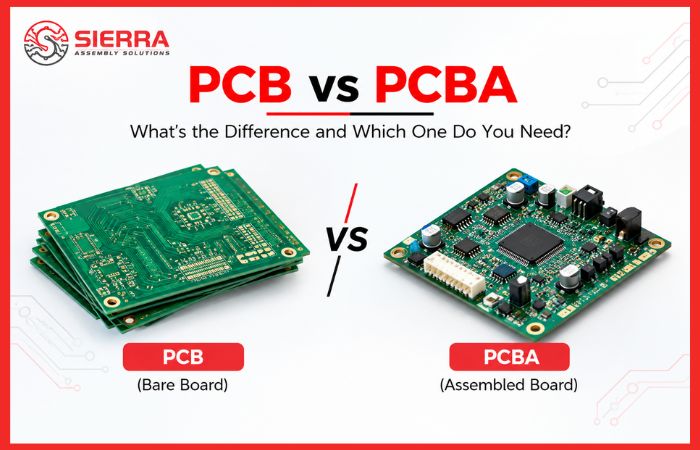
A Printed Circuit Board or PCB for short is essentially the foundation of any electronic device. Think of it as the skeleton. It's that green (or sometimes blue, red, or black) board you see when you crack open a remote control or peek inside your laptop.
The board itself consists of layers. You've got your substrate material, usually FR4 fiberglass, with copper traces etched onto it. These traces act like highways for electrical signals to travel between different points on the board. There are also pads, holes, and various markings that tell you where components will eventually go.
But here's the key point: a PCB on its own doesn't do anything. It's waiting for components.
The manufacturing process involves several steps. First, the design gets transferred onto copper-clad laminate. Then, unwanted copper gets etched away, leaving only the circuit pattern. Holes get drilled for through-hole components. A solder mask gets applied (that's what gives the board its color). Finally, a silkscreen layer adds labels and markers.
Most PCB manufacturers in the USA can turn around standard boards in 3-5 days for prototypes. Production runs take longer, obviously, but the process is pretty streamlined at this point.
So Then What's a PCBA?
PCBA stands for Printed Circuit Board Assembly. Notice that extra letter? That "A" changes everything.
A PCBA is a PCB that's gone through the assembly process. All the electronic components resistors, capacitors, integrated circuits, connectors have been soldered onto the board. It's a complete, functional unit ready to be installed into your final product.
The assembly process typically happens in one of two ways: Surface Mount Technology (SMT) or Through-Hole Technology (THT). Sometimes you'll see both on the same board.
With SMT, tiny components get placed on the surface of the board and soldered using a reflow oven. It's fast, automated, and allows for incredibly dense component placement. Through-hole assembly involves components with leads that go through holes in the board and get soldered on the other side. It's more labor-intensive but creates stronger mechanical bonds.
The PCBA process requires specialized equipment. We're talking pick-and-place machines, reflow ovens, wave soldering equipment, and inspection systems. This is why most companies don't handle assembly in-house they send their PCBs to a contract manufacturer.
The Critical Difference Between PCB and PCBA
Let's cut to the chase. The difference boils down to this:
PCB = The bare board PCBA = The populated, assembled board
When you order a PCB, you receive a board with traces and pads but no components. You'll need to either assemble it yourself or send it to an assembly house.
When you order a PCBA, you receive a complete assembly. The manufacturer has sourced all the components, placed them, soldered them, and tested the board. You can plug it in and use it (assuming everything went according to plan).
This distinction matters more than you might think. I've worked with clients who ordered PCBs thinking they were getting assembled boards, only to receive bare boards and realize they had no way to populate them. That's an expensive mistake, particularly if you've already committed to delivery dates with your customers.
The pricing structure differs significantly too. A PCB might cost $50-$200 for a small production run. That same board as a PCBA could run $300-$800 or more, depending on component costs and assembly complexity. You're paying for the components, the assembly labor, and the testing.
When You Need Just a PCB
There are legitimate scenarios where ordering bare PCBs makes perfect sense.
If you're prototyping and plan to hand-assemble boards yourself, bare PCBs work great. You can iterate on your design without committing to full assembly runs. Many engineers prefer this approach during the development phase because it gives them complete control.
Educational projects often use bare PCBs. Students learning electronics can practice soldering and component placement. It's a hands-on way to understand how circuits actually work.
Some companies maintain in-house assembly capabilities for small batches or specialized products. If you've already invested in pick-and-place equipment and reflow ovens, buying bare PCBs and assembling them internally might make sense financially.
There's also the situation where you're working with highly specialized or hard-to-source components. Sometimes it's easier to procure these yourself rather than relying on an assembly house to track them down. In these cases, you'd order bare PCBs and handle the assembly with your consigned components.
When You Need a Complete PCBA
For most commercial products, PCBA is the way to go. The reasons are pretty straightforward.
First, quality and consistency. Professional assembly houses have calibrated equipment, trained operators, and quality control processes that catch defects before boards ship. Your yield rates will almost certainly be higher than if you're assembling boards manually or with limited equipment.
Second, speed to market. A contract manufacturer can assemble hundreds or thousands of boards faster than you could set up an internal assembly line. Time is money, and if you're racing to launch a product, professional assembly makes sense.
Third, the economies of scale. Assembly houses buy components in bulk and get better pricing than you could negotiate for a small order. They've also optimized their processes to minimize waste and rework. The per-unit cost of PCBA often ends up lower than you'd achieve assembling boards yourself, once you factor in labor, equipment depreciation, and yield losses.
Testing is another big factor. Most PCBA services include functional testing, automated optical inspection (AOI), and sometimes
X-ray inspection for hidden solder joints under components like BGAs. This catches problems before boards get integrated into your product.
The PCB Manufacturing Process Explained
Understanding how PCBs get made helps you make better design decisions and communicate more effectively with manufacturers.
The process starts with your design files, typically in Gerber format. These files contain all the information needed to fabricate the board copper layers, drill files, solder mask, silkscreen, and board outline.
The manufacturer begins with copper-clad laminate sheets. For a standard 2-layer board, you'd have copper on both sides of an FR4 core. Multi-layer boards get built up with alternating layers of prepreg (pre-impregnated fiberglass) and copper, all laminated together under heat and pressure.
A photoresist film gets applied to the copper. Then the circuit pattern gets transferred using UV light and a photomask. The exposed photoresist hardens while the covered areas remain soft. Chemical etching removes the unwanted copper, leaving your circuit traces.
Drilling comes next. Modern CNC drilling machines can hit tolerances of ±0.002 inches, creating holes for through-hole components and vias that connect different layers. For very small holes (under 0.015 inches), laser drilling might be used instead.
After drilling, the holes get plated to make electrical connections between layers. This involves electroless copper deposition followed by electroplating to build up the required thickness.
The solder mask application is actually more complex than it looks. The mask protects the copper traces from oxidation and prevents solder bridges during assembly. Areas where components will be soldered the pads get left exposed.
Silkscreen printing adds the component designators, polarity markers, and any other reference information. This layer helps during assembly and troubleshooting.
Finally, a surface finish gets applied to the exposed copper pads. Common options include HASL (Hot Air Solder Leveling), ENIG (Electroless Nickel Immersion Gold), or OSP (Organic Solderability Preservative). Each has tradeoffs between cost, shelf life, and performance.
Quality control happens throughout the process, but final inspection typically includes electrical testing (either flying probe or fixture-based), dimensional verification, and visual inspection for defects.
The PCBA Assembly Process Step by Step
The PCBA process transforms those bare boards into functional assemblies, and it's actually fascinating to watch if you ever get the chance to visit a contract manufacturer.
Everything starts with component procurement. For turnkey assembly, the CM sources all the parts. For consigned assembly, you provide some or all components. Either way, incoming inspection verifies that components meet specifications and aren't counterfeit (yes, that's a real problem in the electronics industry).
Solder paste application is the first assembly step for SMT boards. A stainless steel stencil precisely aligned to the PCB allows solder paste to be squeegeed onto the pads. The paste consists of tiny solder spheres suspended in flux. Getting the right amount is critical too much and you risk solder bridges, too little and you get cold joints.
Component placement happens next, usually with automated pick-and-place machines. These machines can place thousands of components per hour with incredible accuracy. They pull components from reels or trays, orient them correctly, and set them onto the solder paste. The paste's tackiness holds components in place temporarily.
Reflow soldering melts the solder paste and creates permanent electrical and mechanical connections. The board travels through a reflow oven with multiple temperature zones. The profile has to be carefully controlled too hot and you damage components, too cool and the solder doesn't flow properly. The whole process takes 5-10 minutes, during which the board heats up, the flux activates, the solder melts and wets the pads, then everything cools down and solidifies.
For through-hole components, the process is different. Components get inserted either manually or with automated insertion equipment, then the board goes through wave soldering. In wave soldering, the bottom of the board contacts a wave of molten solder that flows through the holes and creates the solder joints.
Inspection catches defects before they become bigger problems. AOI systems use cameras and algorithms to check component placement, orientation, and solder joint quality. X-ray inspection verifies hidden joints under packages like BGAs or QFNs. Some manufacturers also do manual visual inspection for critical products.
Functional testing verifies that the assembled board actually works. This might be as simple as powering it up and checking voltage rails, or as complex as running through a full test protocol that exercises every feature. The level of testing depends on the product and what's been negotiated with the customer.
Conformal coating is an optional step where a protective polymer layer gets sprayed or brushed onto the assembly. This protects against moisture, dust, and chemicals important for products used in harsh environments.
Finally, the boards get packaged and shipped. Packaging methods depend on how the boards will be used. Some go in anti-static bags, others in custom foam inserts, and high-reliability products might be individually boxed.
Cost Breakdown: PCB vs. PCBA Pricing
Money talks, so let’s talk about what drives the cost.
For a simple two-layer PCB of moderate size, pricing depends heavily on production volume. Prototyping small quantities tends to cost more per board, while larger production runs quickly bring down the cost per unit due to economies of scale.
When that same board becomes a PCBA (assembled with components), the expenses rise because of the added materials and labor. The component cost usually dominates the budget simple resistors or capacitors add little, but complex integrated circuits, connectors, and displays can significantly increase total cost. After that, assembly work and testing contribute the next biggest portions.
It’s also important to factor in Non-Recurring Engineering (NRE) costs one-time charges for tasks like setting up assembly equipment, building test fixtures, developing test procedures, and creating stencils. These costs are spread across your entire production volume, which means they have a bigger impact on small batches than on large-scale production.
Finally, turnaround time influences cost too. The faster you need your boards, the more you can expect to pay. Standard lead times are typically a few weeks, but expedited options come at a premium.
Design Considerations for PCB vs PCBA
Your design approach should account for whether you're doing bare PCB or full assembly.
If you're designing for PCBA, design-for-manufacturing (DFM) principles become critical. Component placement needs to accommodate the assembly process adequate spacing between parts, proper orientation for automated placement, accessible test points, fiducials for machine vision alignment.
Panel utilization matters for cost optimization. Assembly houses often charge by panel, so fitting more boards per panel reduces per-unit costs. Standard panel sizes are 18x24 inches, though some equipment can handle larger formats.
Through-hole components create challenges for automated assembly. If possible, stick with SMT components. When you must use through-hole parts, group them together to minimize the number of process steps.
Component availability is something designers sometimes overlook. Specify parts that are readily available from major distributors. Check lifecycle status you don't want to design in a component that's going obsolete next year. Have acceptable alternates identified for critical components.
For bare PCB design, you have more flexibility since you're not optimizing for automated assembly. Hand assembly is more forgiving of tight component spacing or non-standard parts. However, you should still follow good PCB design practices for signal integrity, power distribution, and thermal management.
Quality Standards and Certifications
Different industries have different quality expectations, and that affects both PCB and PCBA manufacturing.
IPC-6012 covers the qualification and performance of rigid PCBs. There are three classes:
-
Class 1: General electronic products (consumer goods)
-
Class 2: Dedicated service electronic products (communications equipment)
-
Class 3: High reliability electronic products (medical, aerospace, military)
Higher classes have tighter tolerances and more stringent acceptance criteria. A Class 3 board might cost 30-50% more than Class 1 due to the additional quality requirements.
For assembly, IPC-A-610 defines the acceptability criteria for electronic assemblies. Again, there are three classes with increasing requirements for things like solder joint quality, component placement accuracy, and cleanliness.
Medical device PCBAs need to meet ISO 13485 requirements, which mandate strict traceability, documentation, and process controls. Automotive boards often require IATF 16949 certification. Military and aerospace products have their own standards (MIL-PRF-55110, AS9100).
These certifications aren't just paperwork they reflect real differences in manufacturing processes, quality control, and testing. A manufacturer certified for medical device assembly has systems in place to ensure lot traceability, environmental controls, and validation that a general electronics assembler might not.
Common Problems and How to Avoid Them
After years in this industry, I've seen the same mistakes repeated over and over. Here's what trips people up.
Ordering bare PCBs when you need assembled boards. This sounds obvious, but it happens more than you'd think. Always clarify whether you're getting bare boards or assemblies. Get a detailed quote that specifies exactly what's included.
Underestimating lead times. PCB fabrication is relatively quick (3-10 days typically), but PCBA takes longer because of component procurement. Long-lead components can stretch timelines to 8-12 weeks. Plan accordingly and identify long-lead items early.
Poor component selection. Specifying parts that are hard to source, expensive, or approaching obsolescence creates problems. Work with your CM during the design phase to vet your bill of materials.
Inadequate testing specifications. If you don't specify how you want boards tested, you might get minimal testing or none at all. Define your testing requirements upfront. What voltages need to be checked? What functions need verification?
Ignoring DFM feedback. When your PCB manufacturer or assembly house flags design issues, take them seriously. They're trying to save you from yield problems and rework costs. Those tight component spacings might look fine in your CAD software but create problems in production.
Version control chaos. Keep tight control over your design files and BOM. I've seen production runs built with outdated files because someone grabbed the wrong version. Use proper revision control and clearly label everything.
Choosing Between USA and Offshore Manufacturing
This is a loaded question, and the answer depends on your priorities.
USA-based PCB manufacturers offer faster communication, shorter shipping times, easier facility visits, and better IP protection. Turnaround can be incredibly fast some shops offer same-day or next-day service for simple boards. The quality is generally consistent, and dealing with issues is straightforward.
The downside? Cost. Domestic
PCB fabrication typically runs 2-4x more than offshore options. For prototypes and quick-turn projects, the premium is often worth it. For production volumes, the economics shift.
Offshore manufacturing (primarily Asia) offers significant cost advantages, especially at volume. Many Asian manufacturers have invested in state-of-the-art equipment and can handle advanced technologies that might be hard to find domestically. The catch is longer lead times (2-4 weeks typically), communication challenges, and potential quality variability.
For PCBA, the decision involves similar tradeoffs. Domestic contract manufacturers provide better communication and faster iterations, which matters during the development phase. Offshore assembly offers dramatic cost savings for production, but you need solid documentation and clear specifications since back-and-forth is harder.
A hybrid approach works well for many companies: prototype domestically for speed and communication, then transition to offshore manufacturing for production once the design is frozen and validated.
The Future of PCB and PCBA Manufacturing
The industry keeps evolving, and several trends are worth watching.
Additive manufacturing (3D printing) for PCBs is gaining traction for prototypes and low-volume specialty boards. You can print conductive traces, eliminating the etching process. It's not ready to replace traditional PCB manufacturing, but it's getting there for certain applications.
Embedded components integrating resistors, capacitors, even ICs into the PCB substrate rather than mounting them on the surface enable higher component densities and better performance for high-frequency applications. The technology exists but remains expensive for most applications.
Flexible and rigid-flex PCBs are becoming more common as products get smaller and more complex. Smartphones, wearables, and medical devices increasingly rely on flex circuits to fit electronics into tight spaces.
On the assembly side, automation continues advancing. Newer pick-and-place machines can handle smaller components with higher accuracy. Machine vision and AI-driven inspection systems catch more defects and reduce false positives.
Lead-free solder has been the standard for years due to RoHS regulations, but research continues into new alloys with better mechanical and thermal properties. Some of the newer formulations approach the performance of traditional tin-lead solder.
Component miniaturization keeps pushing boundaries. We're now seeing 01005 components (0.016 x 0.008 inches) in production and 008004 components (0.008 x 0.004 inches) in development. At that scale, a grain of salt looks enormous.
Should You Outsource or Build In-House Capability?
This is one of the biggest strategic decisions you'll make, and there's no one-size-fits-all answer.
Building in-house assembly capability requires significant investment. A basic SMT line with pick-and-place machine, reflow oven, and inspection equipment runs $100,000-$300,000 for entry-level equipment. Professional-grade equipment can easily exceed $1 million. Then you need trained operators, maintenance, and ongoing material costs.
The payback period depends on your volume and product mix. If you're building thousands of boards per month with stable designs, in-house assembly might make financial sense. The break-even point is typically somewhere around 5,000-10,000 boards per year, though this varies widely.
The advantage of in-house capability is control. You can iterate quickly, prioritize urgent projects, and protect IP that you might not want to share with an outside contractor. The flexibility can be valuable during product development.
The downside is the distraction. Running an assembly operation isn't trivial. Equipment breaks, processes need optimization, quality systems need maintenance. Unless this is your core competency, it pulls resources away from what you do best.
For most companies, outsourcing makes sense. Partner with a reliable contract manufacturer, establish good communication, and focus your resources on design and development rather than manufacturing operations.
Making Your Decision
So, PCB vs PCBA which do you need?
If you're prototyping and comfortable with assembly, or if you have in-house capabilities, bare PCBs might work. You'll save money upfront and maintain control over the assembly process.
If you need production quantities, lack assembly equipment, or want to ensure consistent quality, PCBA is the better choice. The higher per-unit cost is offset by reliability, faster turnaround, and professional testing.
For most commercial products, PCBA is the path forward. The assembly process requires specialized equipment and expertise that's hard to replicate in-house unless you're committed to building that capability.
Don't make this decision in a vacuum. Talk to potential manufacturing partners early in your design process. Get quotes for both PCB and PCBA options. Understand what each includes and what assumptions are baked into the pricing.
Your product requirements should drive the decision. High-reliability applications like medical devices or aerospace products need professional assembly with rigorous testing. Consumer products with tight margins might benefit from bare PCB procurement with offshore assembly.
Think about your timeline too. If you're racing to market, paying for turnkey PCBA service accelerates your schedule significantly compared to managing PCB fabrication and assembly as separate processes.
Frequently Asked Questions
Can I get both PCB and PCBA from the same manufacturer?
Many contract manufacturers offer both services, which can simplify logistics. However, some specialize in one or the other. Shops that do both typically fabricate PCBs either in-house or through preferred partners, then handle assembly. This provides better integration and accountability, though you might get better pricing by sourcing separately if you're willing to manage multiple vendors.
How long does PCB fabrication take compared to PCBA?
Standard PCB fabrication runs 5-10 business days for most designs. Rush service can deliver in 24-72 hours. PCBA takes longer due to component procurement and assembly typically 2-4 weeks for standard service. The component lead times drive the schedule. If you're providing components (consigned assembly), the timeline compresses significantly.
What information do I need to provide for a PCBA quote?
You'll need your PCB design files (Gerbers, drill files), a complete bill of materials (BOM) with manufacturer part numbers, and any special assembly requirements. Include quantity, desired lead time, and testing requirements. The more detailed your specifications, the more accurate the quote.
Is it cheaper to assemble boards myself?
For very small quantities (under 10 boards), hand assembly might be cheaper than paying NRE charges and setup fees. Beyond that, professional assembly usually wins on cost due to better component pricing, higher yields, and faster throughput. Factor in your time too hand-assembling a complex board can take hours, and your time has value.
What's the minimum order quantity for PCBA?
The minimum order quantity (MOQ) for PCB assembly depends on the manufacturer and the nature of your project. Some manufacturers focus on volume production and set order minimums based on total project value, while others specialize in prototyping and accept very small runs even single units though those tend to carry higher per-board costs.
For early-stage development or testing, prototype assembly services usually allow small batches, while larger production runs become more cost-effective as quantities increase.
Do I need to buy extra PCBs for assembly?
Yes, you should. Assembly yields are never 100%, especially for complex boards. Ordering 10-15% extra boards provides buffer for assembly defects. Your contract manufacturer can advise on appropriate overages based on the complexity of your assembly.
What's the difference between turnkey and consigned assembly?
Turnkey assembly means the contract manufacturer procures all components and handles everything. You provide design files and specifications, they deliver finished boards. Consigned assembly means you purchase and provide some or all components. There's also partial consignment where you provide certain components (maybe long-lead items or parts you've already purchased) and they source the rest.
How do I protect my IP when outsourcing PCBA?
Use NDAs (non-disclosure agreements) with any manufacturer you work with. For highly sensitive designs, consider splitting the work have one company fabricate PCBs and another do assembly. USA-based manufacturers provide better IP protection than offshore options since US legal recourse is more straightforward. For extremely sensitive projects, in-house assembly might be warranted despite higher costs.
Summary on PCB vs PCBA
The distinction between PCB and PCBA isn't just semantics it fundamentally affects your project timeline, costs, and quality. A PCB is your starting point, the canvas on which your electronic design comes to life. A PCBA is the finished product, tested and ready for integration.
Most commercial products benefit from professional PCBA services. The investment in quality equipment, trained operators, and testing infrastructure pays dividends in yield rates and reliability. Unless you're building in-house capability for strategic reasons, outsourcing makes sense.
For prototypes and development work, the calculus is different. Hand-assembling a few boards yourself or working with a quick-turn prototype service gives you flexibility to iterate without committing to full production.
The key is understanding exactly what you need and communicating that clearly with your manufacturing partners. Whether you need bare boards or complete assemblies depends on your resources, timeline, volume, and product requirements.
Choose wisely, specify clearly, and you'll avoid the expensive mistakes that plague projects every day. The difference between PCB and PCBA might be just one letter, but it represents thousands of dollars and weeks of time in your project schedule.
Related Blogs